$ ciarustcode proof search
Query the ledger like evidence
Verifies the chain first, then filters events — by event type, consent tier, file, plan step, outcome or time window. Add --json and it feeds straight into your own tooling.
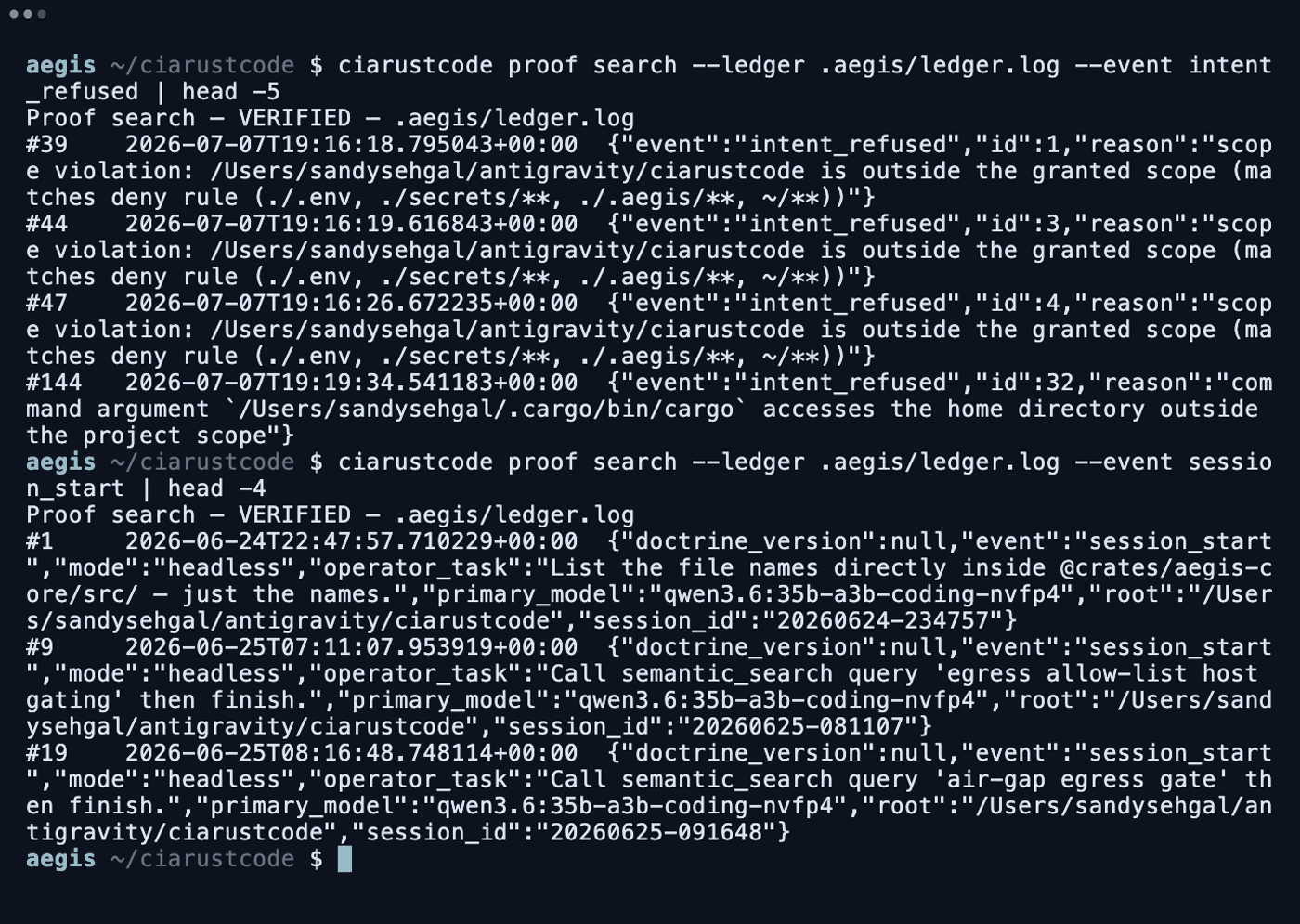
Self-review · the audit surface
Every intent, decision, consent, diff, command and network call AEGIS makes is appended to a ledger that is append-only, hash-chained and Ed25519-signed. The agent can't edit it — it can't even read it. Four commands turn that record into answers.
Free to share — plain markdown, no tracking, no sign-up.
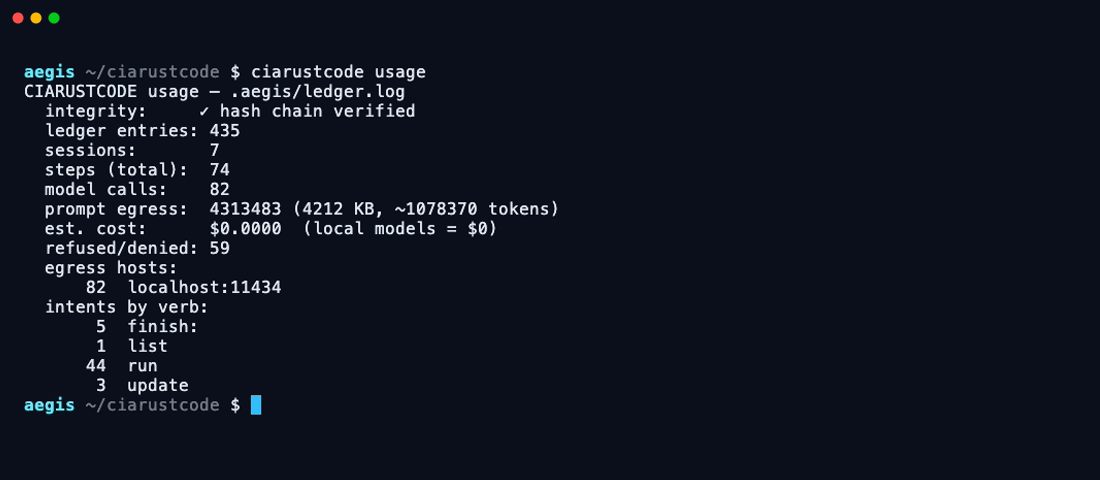
Integrity
Re-computes the ledger's hash chain from entry #0 and checks every Ed25519 signature. If anyone — including the agent, including you — edited, deleted or reordered a single entry, the chain breaks and verify exits non-zero. Pin your device key with --device <hex> to also authenticate who wrote it.
When to reach for it: Run it after any session you care about, in CI after agent jobs, or before trusting a ledger someone hands you.
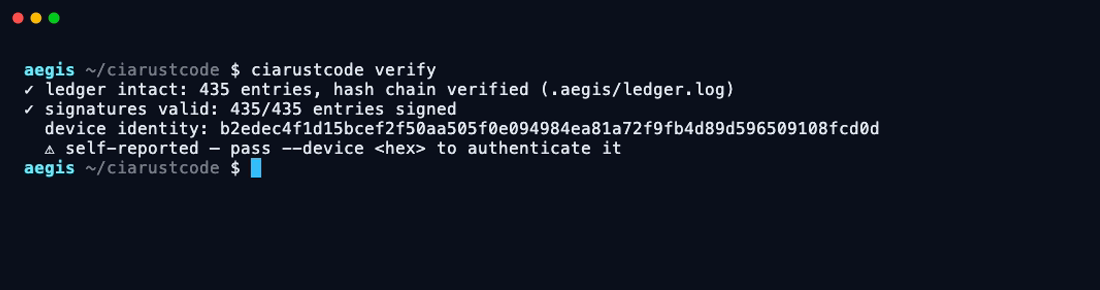
The transcript
Prints the full session transcript from the ledger — one timestamped line per event: session start, every model egress with byte counts, every intent proposed with the policy rule that classified it, every execution, every consent decision, every checkpoint. It's the agent's black-box flight recorder, in plain JSON.
When to reach for it: Use it for post-incident review, code review of the agent's process, or just to see why the policy engine denied something.
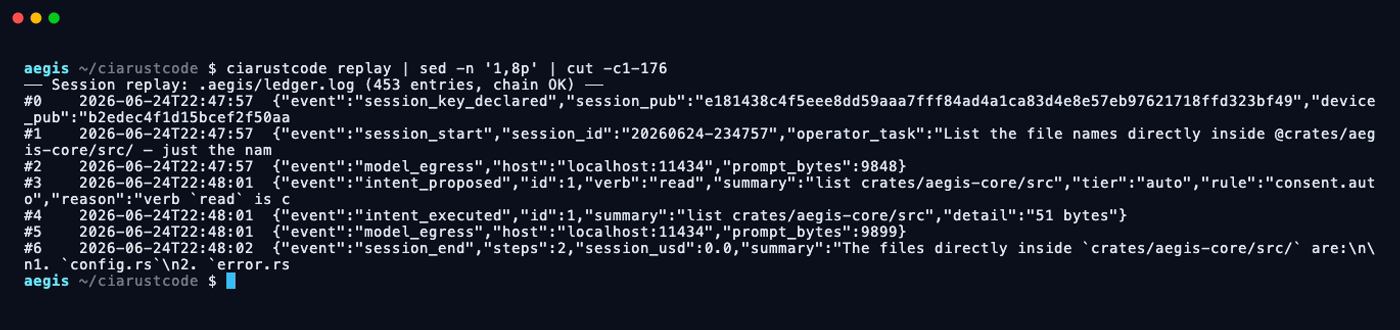
Cost & egress
Aggregates the ledger into a usage report: sessions, steps, model calls, prompt egress in bytes and tokens, estimated cost (local models are $0), how many intents were refused or denied, a histogram of every network host contacted, and intents by verb. If a host you don't recognise appears in that list, you'll see it here first.
When to reach for it: Weekly cost/egress reviews, or as the honest answer to 'what has this agent been doing on this repo?'
Portable proof
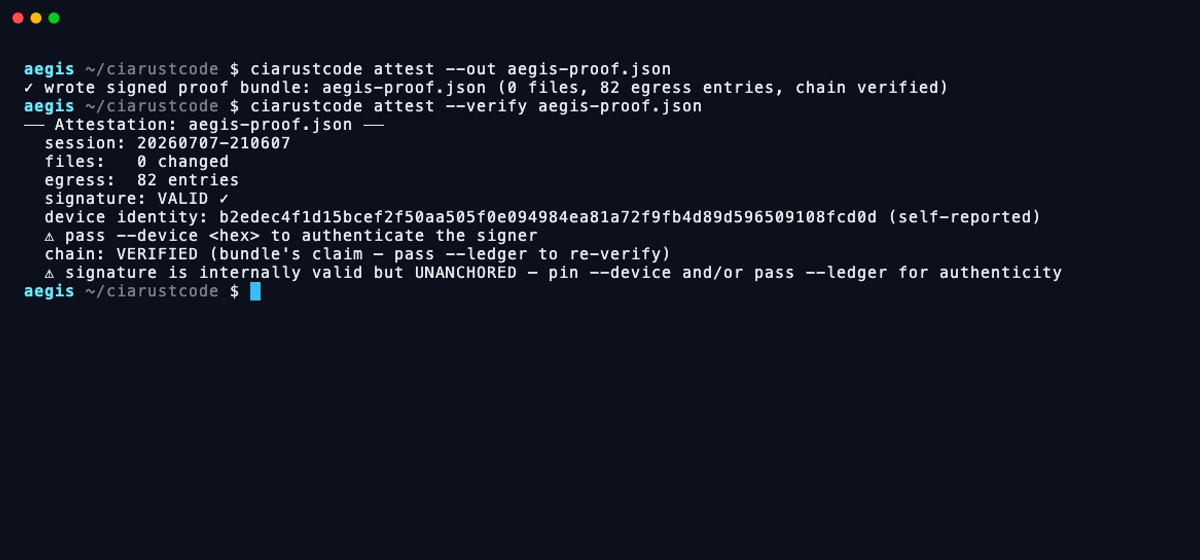
Exports a portable, signed proof bundle: file hashes of what changed plus the complete egress manifest, signed with the device key. Anyone can check it later — offline — with ciarustcode attest --verify proof.json. Pass --device <hex> to pin the expected signer so a forged-identity bundle is rejected outright.
When to reach for it: Hand it to a client, an auditor or a regulator as evidence of exactly what an agent engagement did — and didn't do.
Beyond the four commands
The four commands above are the spine. Around them sits a wider audit surface — search, dry-run, comparison and export tools that all obey the same rule: they only read — the verified record, or your policy file — and they can never cause an effect.
$ ciarustcode proof search
Verifies the chain first, then filters events — by event type, consent tier, file, plan step, outcome or time window. Add --json and it feeds straight into your own tooling.
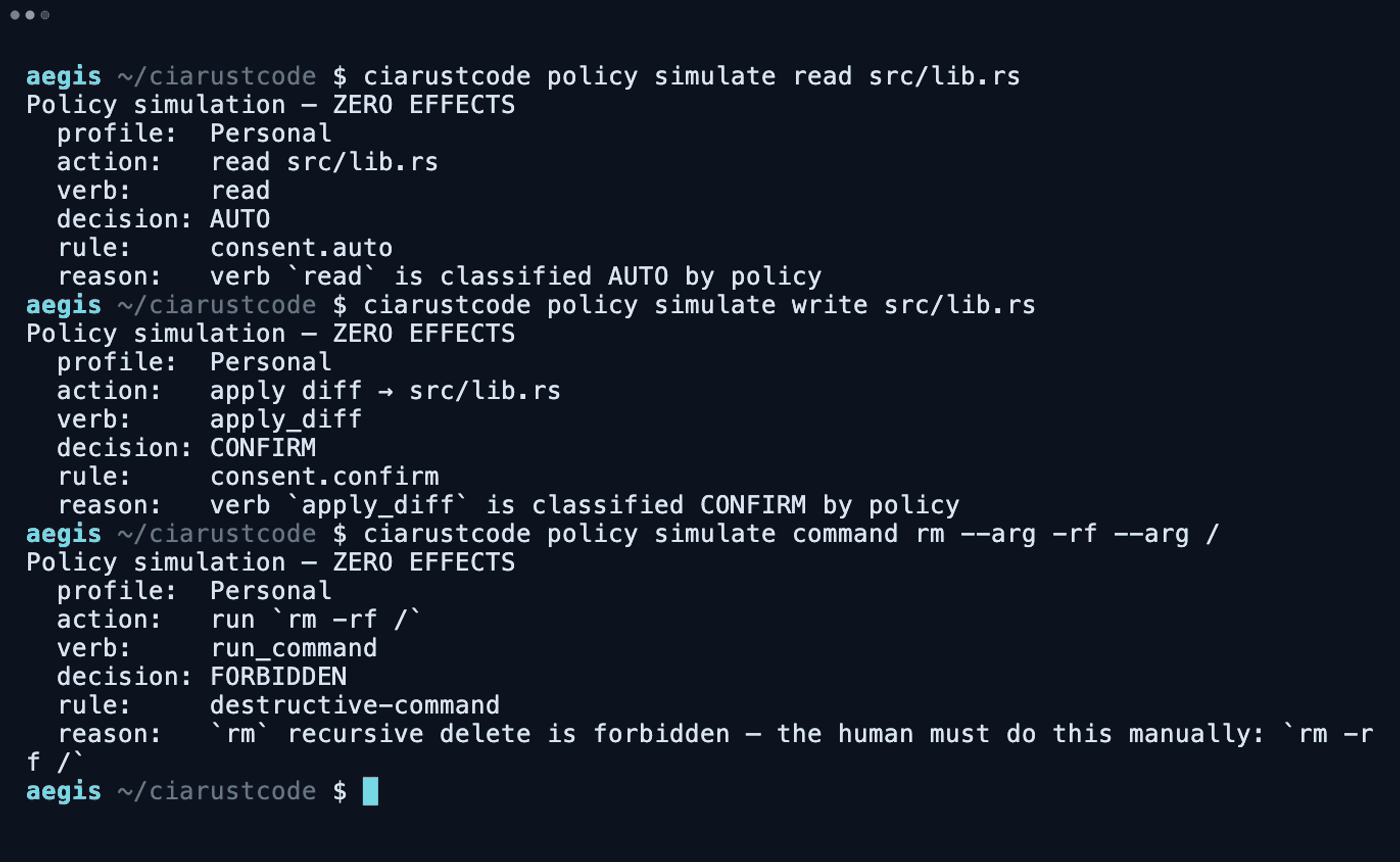
$ ciarustcode policy simulate
Builds a real typed intent and passes it through the real scope and policy classifier — reads, writes, commands, network calls, dependency installs, git pushes, browser navigation. No broker, no shell, no writes: the answer includes the tier, the matched rule and the reason.
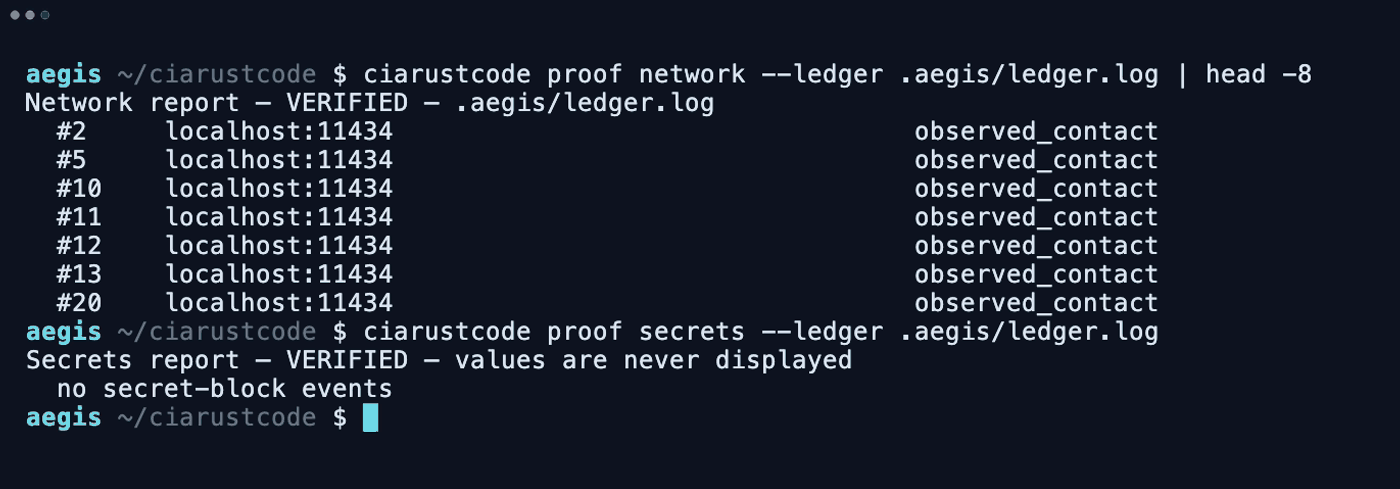
$ ciarustcode proof network · proof secrets
Network destinations are reported as observed, blocked and authorised-scope — three separate lists, not one blur. Secret-block events are reported by pattern name, never by the secret's value.
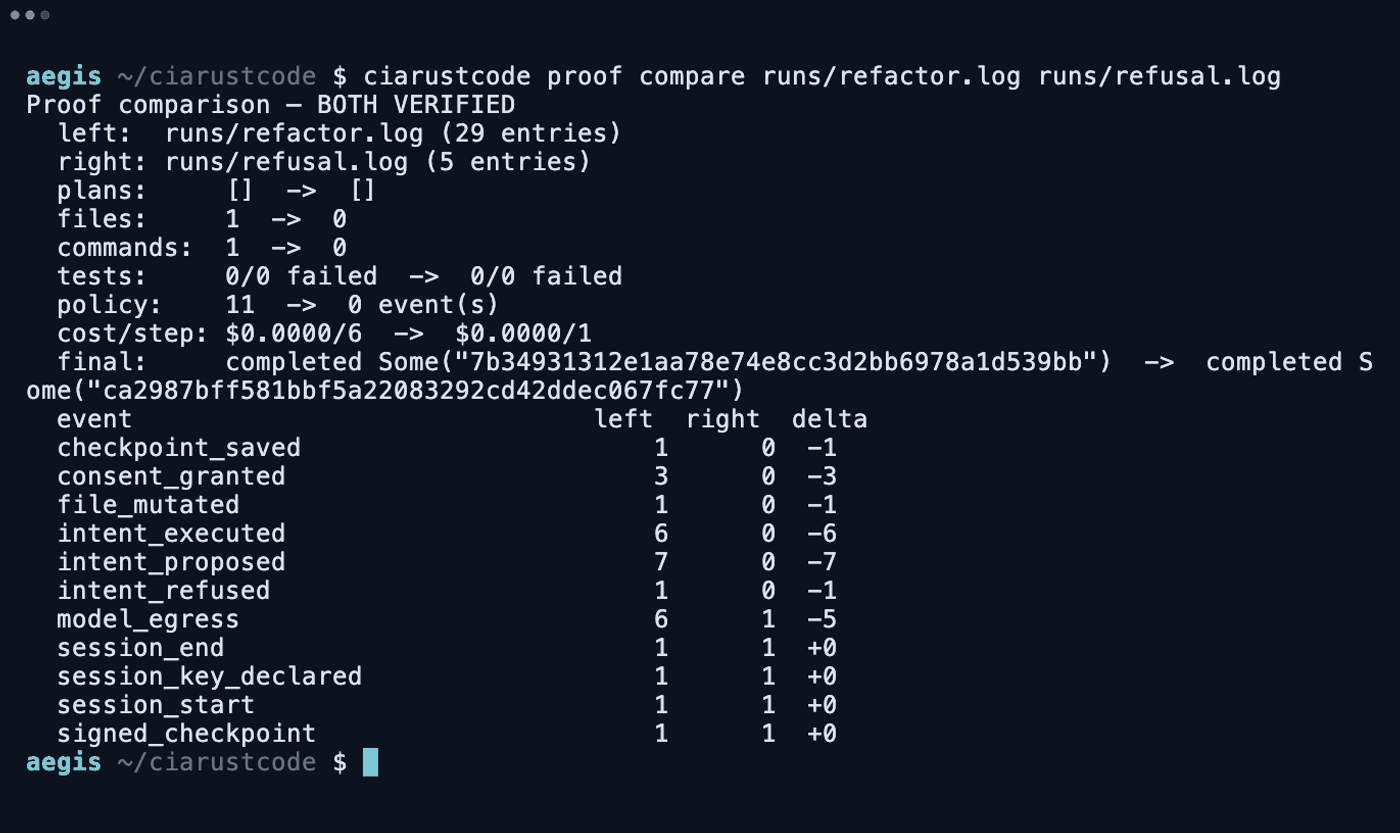
$ ciarustcode proof compare
Sets two verified ledgers side by side and diffs their typed-event counts — a failed run against its corrected re-run, or last week's session against today's.
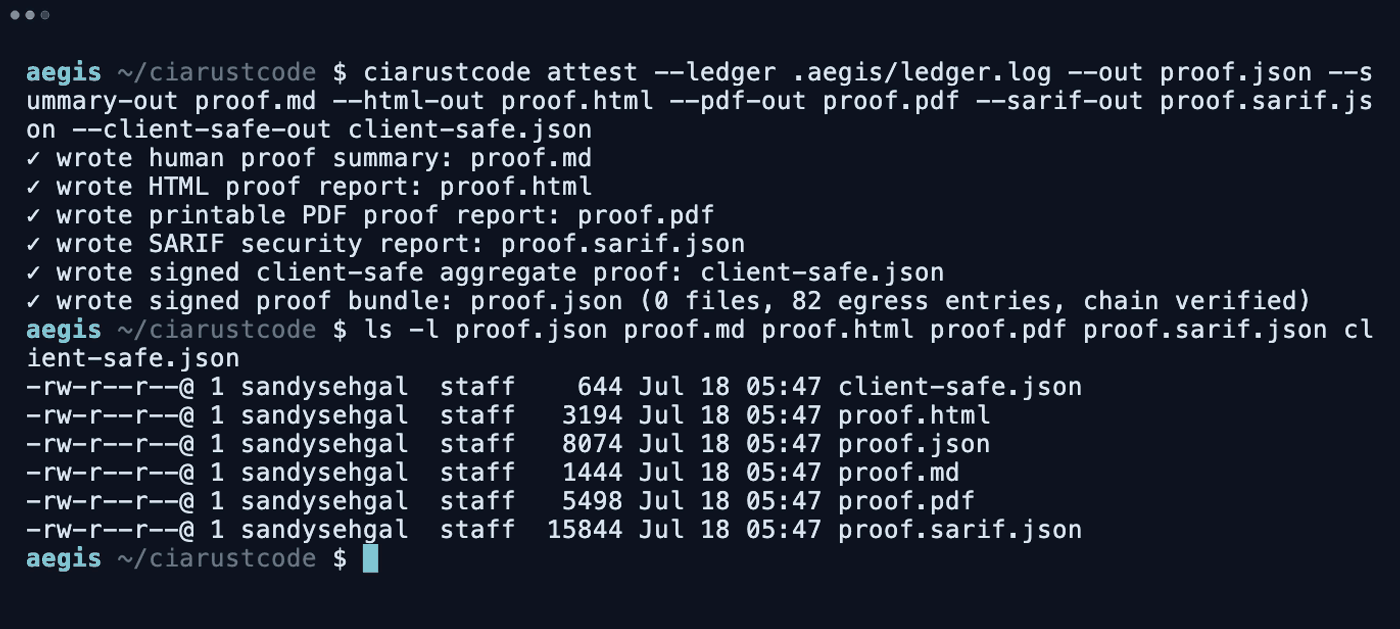
$ ciarustcode attest --pdf-out · --sarif-out · --client-safe-out
The signed JSON evidence bundle plus five companions: Markdown, self-contained HTML, printable A4 PDF, SARIF 2.1.0 for security tooling, and a separately signed client-safe summary that reconciles to the full bundle's digest.
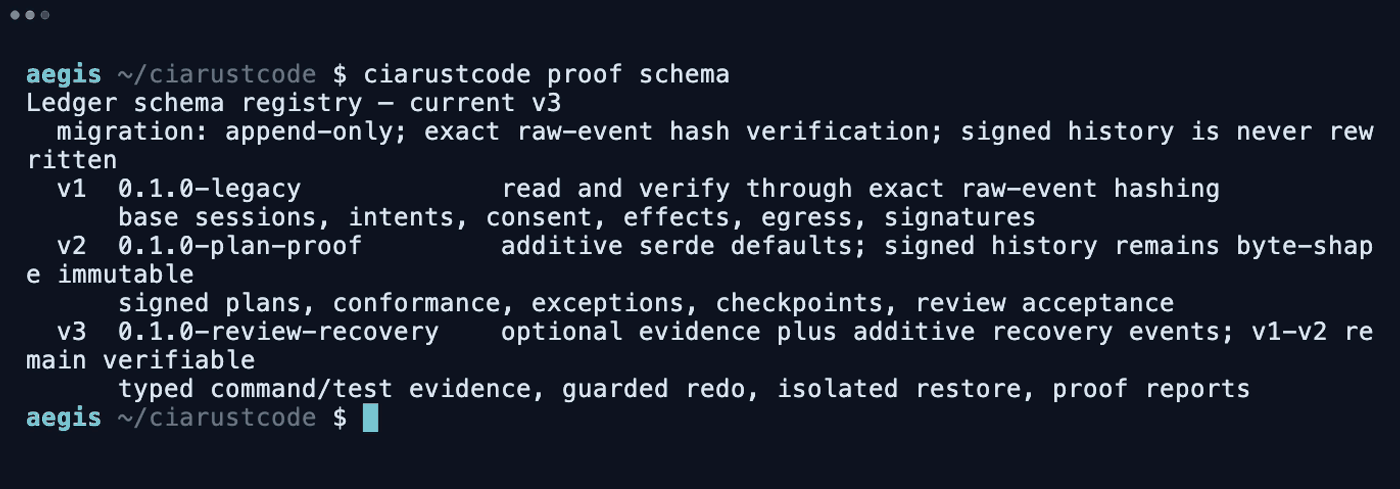
$ ciarustcode proof schema
A compiled, append-only event-schema registry. Historic ledgers verify against the exact raw bytes stored on disk — compatibility code never rewrites old events to make them look current.
How the ledger resists tampering
Each entry carries a fingerprint — a cryptographic hash — of the entry before it, so the whole log links together like a chain. Change a single byte anywhere and every later link stops matching, and verify points to exactly where it broke.
Each entry carries an unforgeable digital signature (using Ed25519, a standard signing algorithm). The signing key is unique to the session and vouched for by a key tied to your machine — so a signature proves which device and session wrote it. A log that's been altered or rebuilt from scratch has no valid keys, so verify rejects it.
The log lives in a folder (.aegis/) that the agent's write permissions structurally exclude. The one process with a motive to lie about the record is never handed a pen.
One markdown file: all four commands, real output shapes, the CI recipe and the threat model they defend against. Share it with your team — that's what it's for.